
Living here
Lawns and gardens
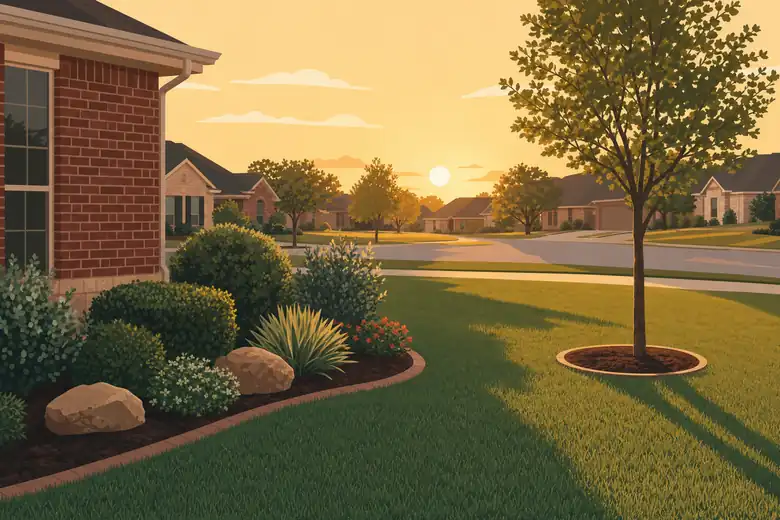
Gardening here comes down to three things. It gets hot early and stays hot, the ground holds water, and the season is long enough to grow two rounds of vegetables a year. Once you know the dates, most of the rest follows.
The ground you're working with
Dig anywhere in Timberwood and you'll hit one of two soils. About two thirds of the lots sit on one called Clodine, and most of the rest on Addicks.1 Both are heavy, and both drain slowly.
Here's what that means in the yard. The ground stays wet a long time after rain. The soil survey says Clodine is soaked for three to six months through winter and spring, and that Addicks has water sitting a foot or two down for a month or two in most years.23 A bed that sits low will stay soggy, and roots sitting in water rot.
That's why raised beds do better here than digging down. A few inches of height is enough.
Go a foot or two down and the dirt turns chalky.3 Chalk makes soil alkaline, so anything that wants acid soil is fighting the ground underneath it. Azaleas and blueberries are the ones people usually try. If you want them, grow them in a container or a raised bed you fill yourself.
You can look up which soil is under your own lot on the map.
The two dates everything hangs on
Our average last freeze is March 1 and our average first freeze is November 30.4 That's nine months between them, which is why two vegetable seasons fit.
Those are the numbers for Bush Intercontinental, which is the airport just north of us. Hobby, on the other side of Houston, averages February 8 and December 20.4 That's three weeks warmer on both ends. So a planting date you read on a Houston gardening page can be three weeks early for us, and the plant pays for it.
Average also means average. Some years the last freeze comes in January and some years it comes in mid March.
Spring
Spring is short and it turns hot fast, so nothing waits.
Your lawn will green up and want mowing. Once you've mowed it twice, it's growing again and that's when the first feeding of the year goes down.5
In the beds, tomatoes and corn go in early March, and peppers, cucumbers and squash follow toward the end of the month. If you're putting in melons, okra or sweet potatoes, those want April, when the ground has warmed up.
Summer, and the heat
By late June most vegetables are done setting fruit. Tomatoes and peppers keep the plant alive but stop producing when the nights stay warm, and that's normal here.
A few things actually like it. Okra, southern peas, sweet potatoes and summer greens run right through July.
Two rules matter more in summer than any other time.
Don't fertilize grass that's already struggling.5 Feeding a lawn that's stressed from heat or drought makes it worse rather than better.
Shade anything you start in the heat. The county planting chart says it plainly: seeds and transplants started in the heat of summer do better with some shade while they get going.4 A piece of shade cloth or an old sheet on stakes for the first couple of weeks is enough.
Fall
Fall is the better season here and most people don't use it. The heat breaks, the bugs slow down, and greens grow beautifully.
Late July into early August is when you set out a second round of tomatoes and peppers for a fall crop. Late September through October is the big window: broccoli, cabbage, cauliflower, collards, kale, lettuce, spinach, carrots, radishes and garlic all go in then.
Fall is also when to stop feeding the lawn, and people get that backwards. See below.
Winter
The lawn goes dormant and mostly wants leaving alone. Mow only if winter weeds are coming up and going to seed.5
Turn the sprinkler system off. The extension service is blunt about it: turn irrigation off through the winter months when the grass isn't growing.5 It isn't drinking, and running it is wasted money.
Greens, carrots and lettuce keep going through the cold. When a freeze is coming, cover them. The county chart notes that anything grown over winter may need protection in freezing weather.4
Watering
Water when the yard needs it rather than on a schedule. The guidance is to irrigate only when it's needed to keep the grass from wilting.5
Skip it during rainy stretches, and skip it in early spring and late fall, when rain usually covers what the lawn needs on its own.5
Water deep and less often rather than a little every day. Shallow daily watering keeps roots near the surface and that is where they dry out first.
Turn it off completely in winter.5
Feeding the lawn
Four things, and the last one is the one people get wrong.
When to start. After you've mowed twice in the spring. That's the sign the grass is actually growing and can use it.5
How much. Half a pound to a pound of nitrogen per 1,000 square feet at a time, one to four times across the year.5 The bag will tell you what that works out to in cups or pounds of product.
Never more than 4 pounds of nitrogen per 1,000 square feet in a year.5 More than that doesn't help and runs off into the ditch.
When to stop. The last feeding of the year should be four to six weeks before the first freeze.5 With our average first freeze on November 30,4 that's somewhere between October 19 and November 2. Feeding after that pushes soft new growth right when the cold shows up, and the cold kills it.
Mow at 2 to 4 inches, and never take off more than a third of the blade at once.5 Cutting it shorter than that scalps it and lets weeds in.
Weeds, bugs and brown patches
Weed prevention goes by ground temperature rather than by the calendar, and that is why the bag never gives you a date. Put down a pre-emergent for summer weeds like crabgrass once the soil has been around 55 degrees for four or five days straight, and for winter weeds once it's been around 70 for the same stretch.5 A cheap soil thermometer settles it. Once a weed is already up, a pre-emergent won't touch it and you need the other kind.
Chinch bugs are the usual summer problem in St. Augustine, and they show up as dead patches in the hottest, sunniest part of the yard.5 Grubs are the other one. Watch for armyworms in late summer.5
Big round brown patches in fall usually mean a lawn disease rather than a watering problem. It gets going when the ground is between 50 and 70 degrees, so fall and early spring are when it turns up.5 If your yard gets it every year, treat before you see it rather than after.
When to plant what
This is the county's planting chart for Harris County, cut down to what people usually grow.4 "Early" means the first half of the month and "late" means the second half. The chart allows a wider window on either side of most of these, so being a week off isn't a lost crop.
| Crop | Spring | Fall |
|---|---|---|
| Tomato | early March to early April | late July to early August |
| Pepper | late March to late April | late July to early August |
| Cucumber | late March to early April | late July to early August |
| Summer squash | late March to late April | early August to late August |
| Green beans | late March | late August to early September |
| Corn | early March to late March | |
| Okra | early April to late July | |
| Southern peas | early April to late July | |
| Sweet potato | early April to late June | |
| Watermelon | early April to late May | |
| Cantaloupe | early April to early June | |
| Broccoli, cabbage, cauliflower | late January to late February | late September to early October |
| Collards and kale | late January to late February | late September to late October |
| Lettuce | late January to late February | early October to late November |
| Spinach | late January to early February | early October to late November |
| Carrots | late January to early February | late October to late November |
| Radish | early February to early March | late September to late November |
| Turnips | early February to late February | late September to late October |
| Onion | early January to early February | late September to late October |
| Irish potato | early February to late February | late August |
| Garlic | late September to early November |
What the city can make you do
Taking a tree down needs a permit from the city, since we're inside the Humble city limits.6 Permits covers the rest of that list. Planting, mowing, beds and a vegetable garden need nothing.
There's no HOA here either, so nobody reviews what your yard looks like. What the city can act on is a yard gone bad enough to be a health problem. Article 7.05 of the city code is about weeds, brush and trash that could breed mosquitoes or attract rats, and standing water that sits.7 There's no height limit in it. A long lawn isn't what it's aimed at.
If the city does act, you get a notice and seven days to fix it before it's an offense.7 The notice goes to whatever mailing address the county has for the property, and a letter that comes back unclaimed still counts as delivered.7
You'll see "grass and weeds over one foot" quoted around town. That line is real but it's in the part of the code about platting a new subdivision, and there the city asks the developer to put it in the deed restrictions.7 It isn't a citywide rule. For us it's a question about Timberwood's 1977 deed restrictions, which nobody here has read yet.
Still open
- Which grass most yards here actually have. This page assumes St. Augustine, which is the common one in this part of Texas, but nobody has walked the streets and checked.
- Whether Humble limits outdoor watering in a drought, and at what stage
- What actually does well here, from people who've grown it. No public record answers that.
- Whether anyone here keeps a vegetable garden, and what they'd tell a beginner
- Whether Article 7.05 has changed since the 2022 version this was read from.7 The live city code sits behind a service that blocks automated reading.
Where this comes from
- Harris CountySoil survey layer, the source of the soil name on every lot on this site's mapgis.hctx.net
- USDA Natural Resources Conservation ServiceClodine soil series, official descriptionsoilseries.sc.egov.usda.gov
- USDA Natural Resources Conservation ServiceAddicks soil series, official descriptionsoilseries.sc.egov.usda.gov
- Texas A&M AgriLife ExtensionVegetable planting dates for Harris Countyharris.agrilife.org
- Texas A&M AgriLife ExtensionSt. Augustine lawn care calendar, EHT-141aggieturf.tamu.edu
- City of HumbleBuilding and Inspectioncityofhumbletx.gov
- City of HumbleCode of Ordinances in the June 23 2022 council packet: Article 7.05 offensive conditions, Article 9.02 subdivisionscityofhumbletx.gov
Related
Someone for this job
Improve this page
Is something here wrong or missing?
Members can suggest a change. The pages marked needs a neighbor are the ones where somebody who lives here is the only source there is.